Bisections
Bisections work by moving an interval until we observe a sign change (either in the function or its derivative).
Example
We consider the same example as we had when demonstrating backtracking line search:
ls_obj = linesearch_problem(s)Bracketing
Performing bisections requires providing an initial interval. If we are only given a single point instead of an interval we have to perform bracketing. For bracketing [3] we move an interval successively and simultaneously increase it in the hope that we observe a local minimum (see bracket_minimum).
α₀ = 0.0
(a, c) = bracket_minimum(alpha -> ls_obj.F(alpha, params), α₀)
(1.28, 5.12)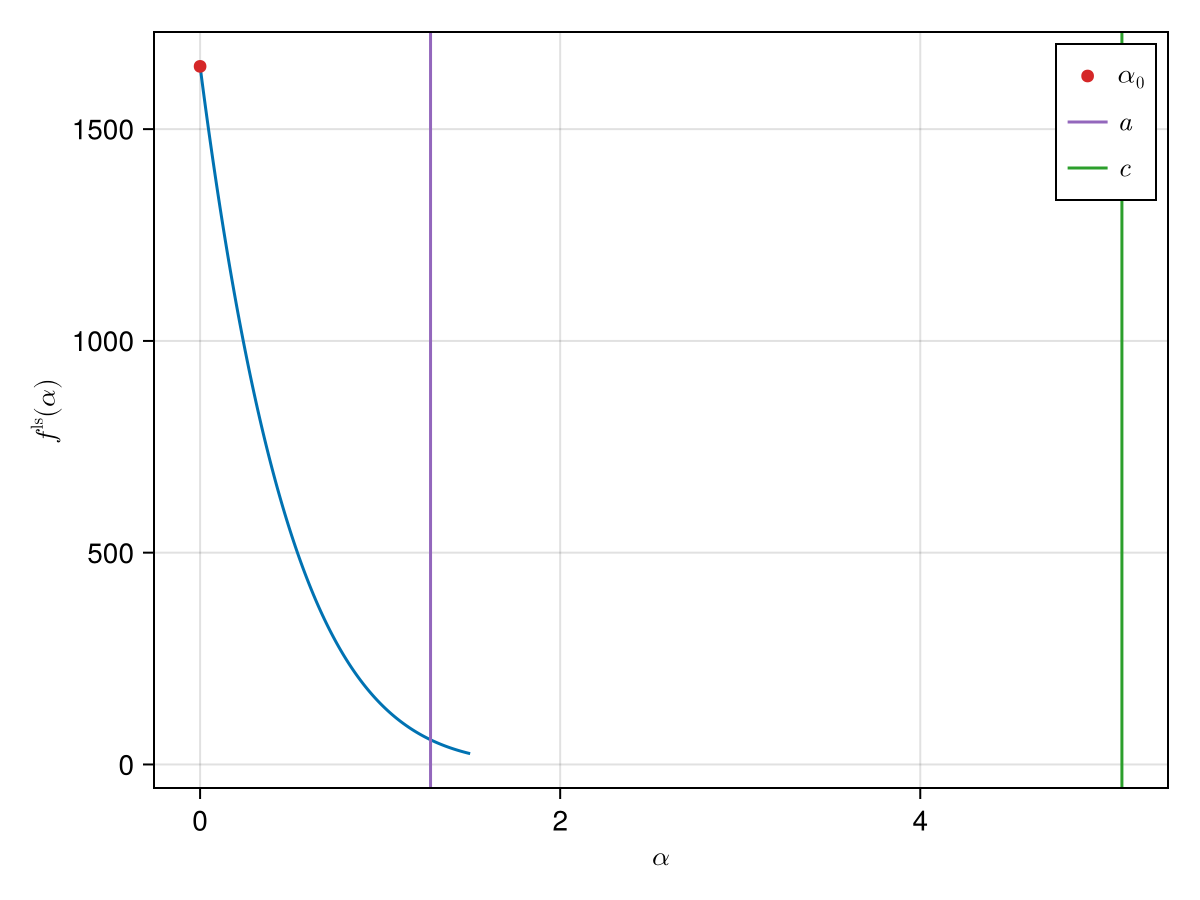
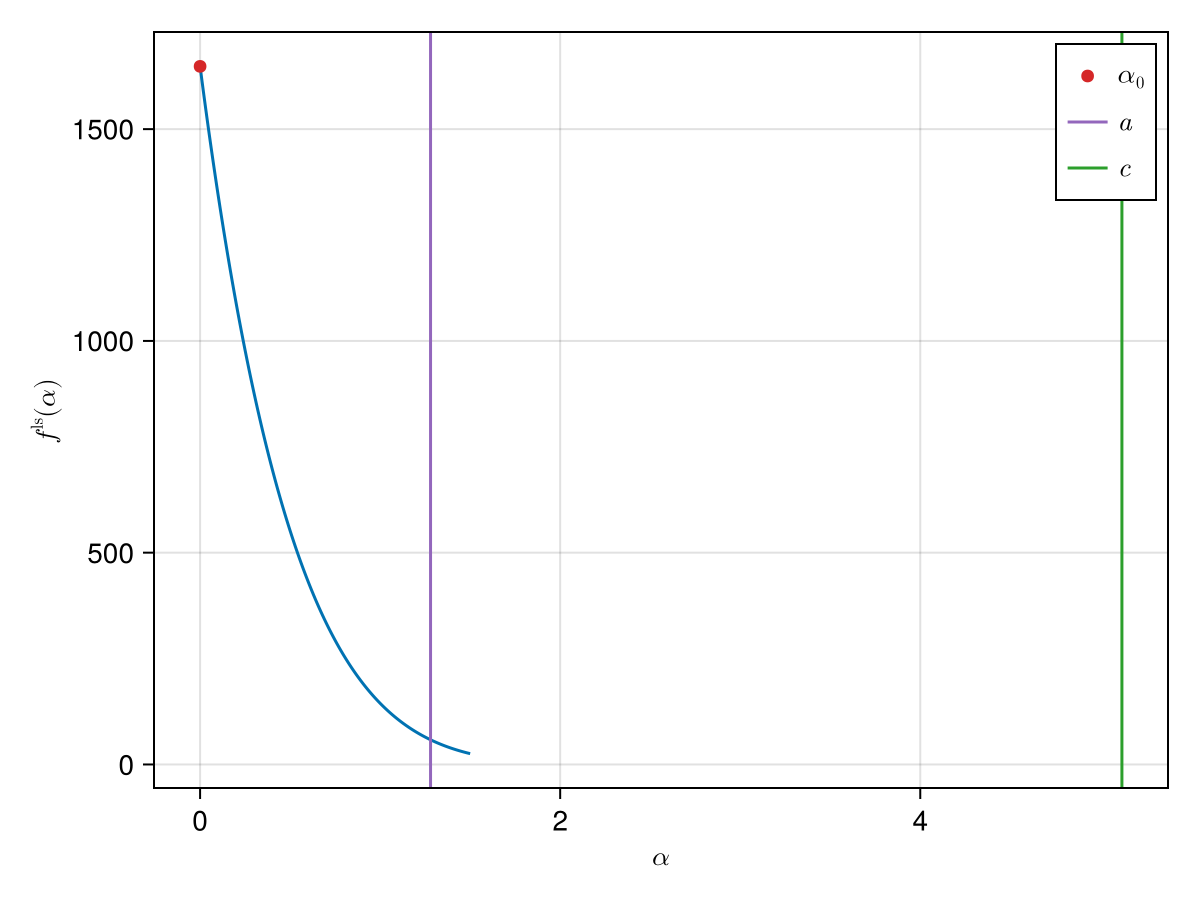
We then use this interval to start the bisection algorithm.
Potential Problem with Backtracking
We here illustrate a potential issue with backtracking. For this consider the following function:
f2(α::T) where {T <: Number} = α^2 - one(T)
α₀ = -10.0
(a, c) = bracket_root(f2, α₀)
(-7.44, 0.23999999999999932)And when we plot this we find:
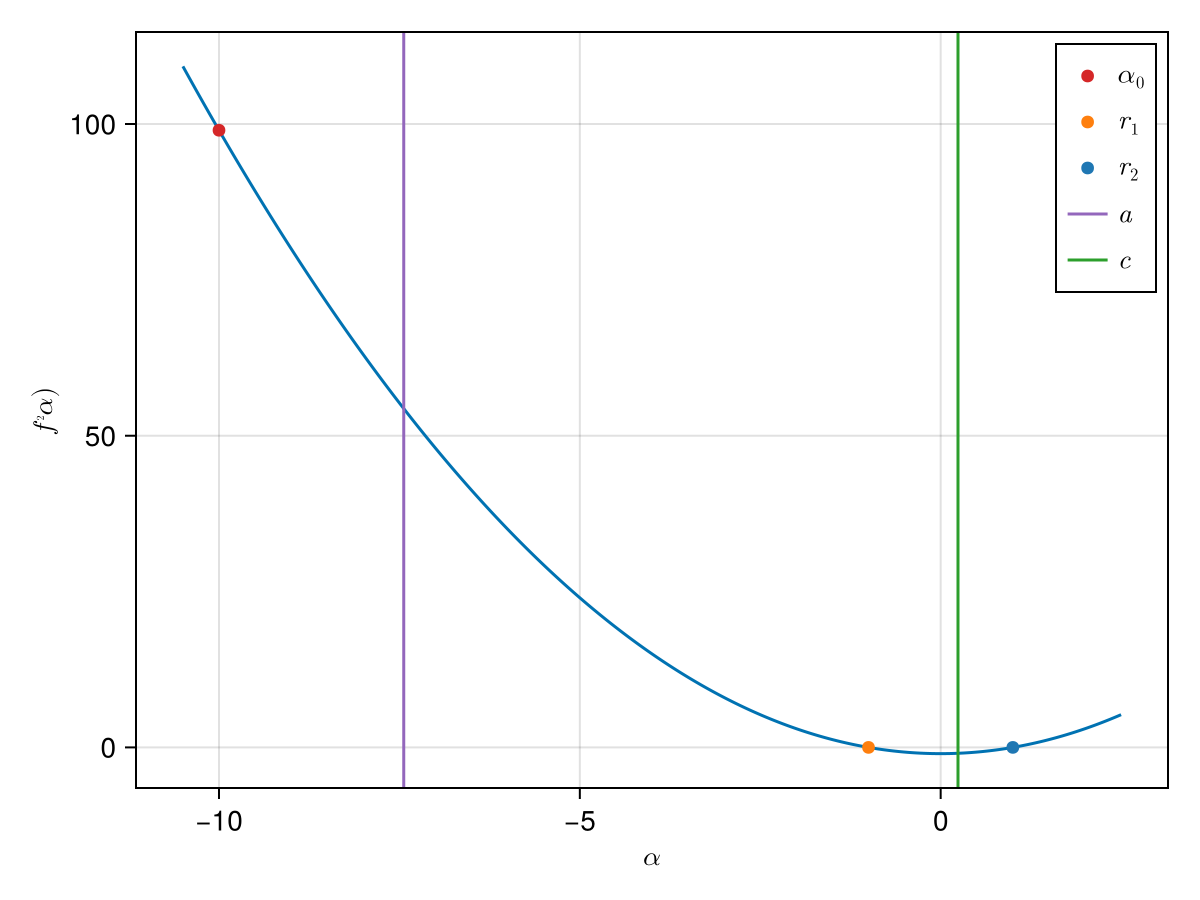
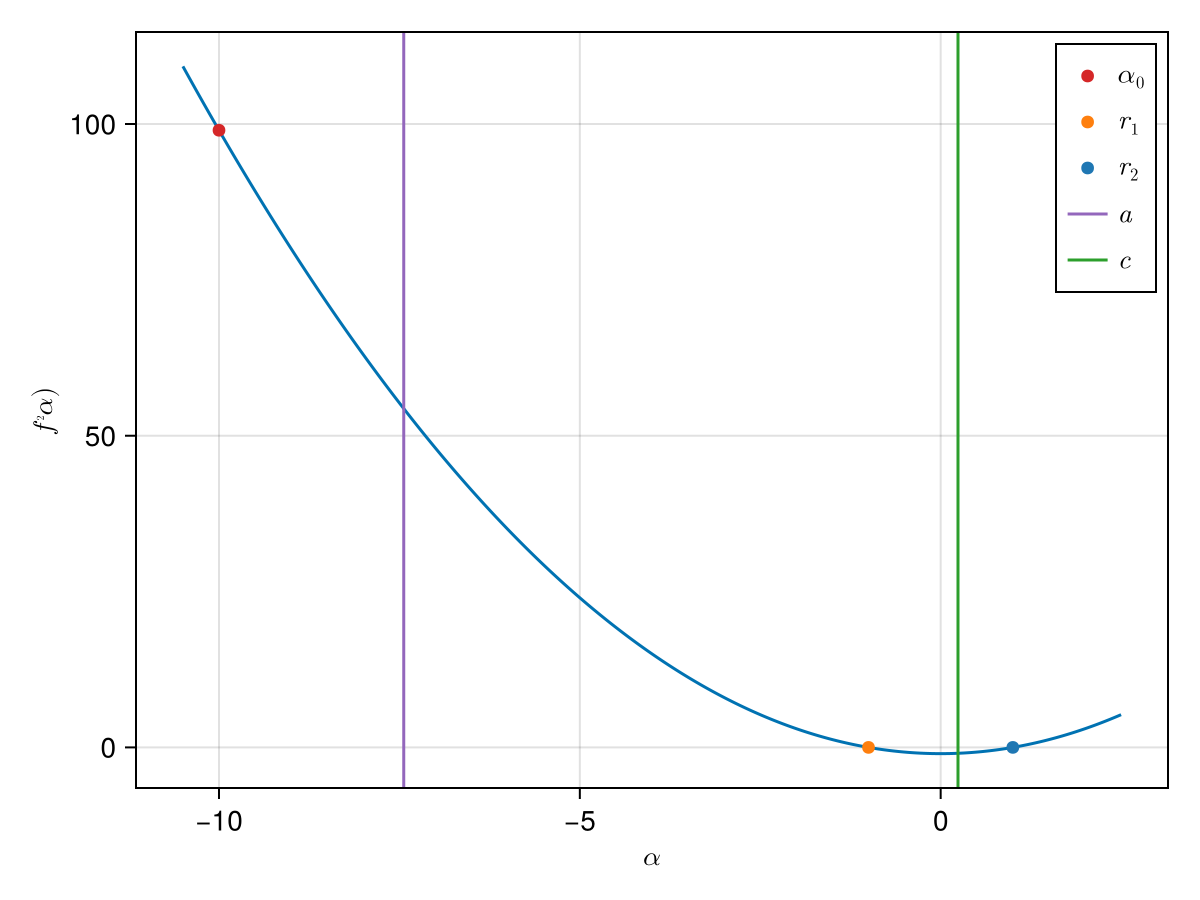
If the interval would contain $r_1$ and $r_2$ then we get an error:
bracket_root(f2, 30.)MethodError: Cannot `convert` an object of type Nothing to an object of type Tuple{Float64, Float64}
The function `convert` exists, but no method is defined for this combination of argument types.
Closest candidates are:
(::Type{T})(::Any) where T<:Tuple
@ Base tuple.jl:450
convert(::Type{T}, ::T) where T<:Tuple
@ Base essentials.jl:650
convert(::Type{T}, ::NTuple{N, Any}) where {N, T<:Tuple}
@ Base essentials.jl:651
...bracket_minimum grows the interval outward until the merit stops decreasing, which on a merit that keeps falling is bounded only by the bracketing budget. The αmax field of Bisection stops it, and a caller with a scale of its own can ask for less; see Bounding the step.