Lagrangian Systems
The Euler-Lagrange equations, that is the dynamical equations of a Lagrangian system, are given in terms of the Lagrangian $L(x,v)$ by
\[\frac{d}{dt} \frac{\partial L}{\partial v} - \frac{\partial L}{\partial x} = 0 .\]
For regular (i.e. non-degenerate) Lagrangians, this is a set of second-order ordinary differential equations. In many numerical applications, it is advantageous to solve the implicit form of these equations, given by
\[\begin{align*} \frac{d \vartheta}{dt} &= f , & \vartheta &= \frac{\partial L}{\partial v} , & f = \frac{\partial L}{\partial x} . \end{align*}\]
In the following, we show how these equations can be obtained for the example of a particle in a square potential.
Particle in a potential
Before any use, we need to load EulerLagrange:
using EulerLagrangeNext, we generate symbolic variables for a two-dimensional system:
t, x, v = lagrangian_variables(2)(t, (x(t))[1:2], (v(t))[1:2])With those variables, we can construct a Lagrangian
using LinearAlgebra
L = v ⋅ v / 2 - x ⋅ x / 2-(1//2)*LinearAlgebra.dot(x(t), x(t)) + LinearAlgebra.dot(v(t), v(t)) / 2This Lagrangian together with the symbolic variables is then used to construct a LagrangianSystem:
lag_sys = LagrangianSystem(L, t, x, v)
Lagrangian system with

L = ((v(t))[1]^2 + (v(t))[2]^2) / 2 - (1//2)*((x(t))[1]^2 + (x(t))[2]^2)
The constructor computes the Euler-Lagrange equations and generates the corresponding Julia code. In the last step, we can now construct a LODEProblem from the LagrangianSystem and some appropriate initial conditions, a time span to integrate over and a time step:
tspan = (0.0, 10.0)
tstep = 0.01

q₀ = [1.0, 1.0]
p₀ = [0.5, 2.0]

lprob = LODEProblem(lag_sys, tspan, tstep, q₀, p₀)
Geometric Equation Problem for Lagrangian Ordinary Differential Equation (LODE)
with vector fields
ϑ = RuntimeGeneratedFunctions.RuntimeGeneratedFunction{(:ˍ₋out, :t, :X, :V, :params), EulerLagrange.var"#_RGF_ModTag", EulerLagrange.var"#_RGF_ModTag", (0x4889eaba, 0x3711d03f, 0x67dd90d3, 0x9ce688d2, 0x5021471b), Expr}(:(#= /home/runner/.julia/packages/Symbolics/mLvup/src/build_function.jl:410 =# @inbounds begin
#= /home/runner/.julia/packages/Symbolics/mLvup/src/build_function.jl:410 =#
begin
#= /home/runner/.julia/packages/SymbolicUtils/c9cTZ/src/code.jl:1264 =# @inbounds begin
#= /home/runner/.julia/packages/SymbolicUtils/c9cTZ/src/code.jl:1260 =#
ˍ₋out[1] = (getindex)(V, 1)
ˍ₋out[2] = (getindex)(V, 2)
#= /home/runner/.julia/packages/SymbolicUtils/c9cTZ/src/code.jl:1262 =#
ˍ₋out
end
end
end))
f = RuntimeGeneratedFunctions.RuntimeGeneratedFunction{(:ˍ₋out, :t, :X, :V, :params), EulerLagrange.var"#_RGF_ModTag", EulerLagrange.var"#_RGF_ModTag", (0x698b640d, 0x25197a89, 0xe965cee8, 0x7fe417c1, 0xbf67a0c5), Expr}(:(#= /home/runner/.julia/packages/Symbolics/mLvup/src/build_function.jl:410 =# @inbounds begin
#= /home/runner/.julia/packages/Symbolics/mLvup/src/build_function.jl:410 =#
begin
begin
var"##cse#1" = -1//1
var"##cse#2" = (*)(var"##cse#1", (getindex)(X, 1))
var"##cse#3" = (*)(var"##cse#1", (getindex)(X, 2))
#= /home/runner/.julia/packages/SymbolicUtils/c9cTZ/src/code.jl:1264 =# @inbounds begin
#= /home/runner/.julia/packages/SymbolicUtils/c9cTZ/src/code.jl:1260 =#
ˍ₋out[1] = var"##cse#2"
ˍ₋out[2] = var"##cse#3"
#= /home/runner/.julia/packages/SymbolicUtils/c9cTZ/src/code.jl:1262 =#
ˍ₋out
end
end
end
end))
g = RuntimeGeneratedFunctions.RuntimeGeneratedFunction{(:ˍ₋out, :t, :X, :V, :Λ, :params), EulerLagrange.var"#_RGF_ModTag", EulerLagrange.var"#_RGF_ModTag", (0xd78db5e6, 0x97238c19, 0xadd210ce, 0xe0bfc6f5, 0x926922e1), Expr}(:(#= /home/runner/.julia/packages/Symbolics/mLvup/src/build_function.jl:410 =# @inbounds begin
#= /home/runner/.julia/packages/Symbolics/mLvup/src/build_function.jl:410 =#
begin
#= /home/runner/.julia/packages/SymbolicUtils/c9cTZ/src/code.jl:1264 =# @inbounds begin
#= /home/runner/.julia/packages/SymbolicUtils/c9cTZ/src/code.jl:1260 =#
ˍ₋out[1] = (getindex)(Λ, 1)
ˍ₋out[2] = (getindex)(Λ, 2)
#= /home/runner/.julia/packages/SymbolicUtils/c9cTZ/src/code.jl:1262 =#
ˍ₋out
end
end
end))
Lagrangian: L = RuntimeGeneratedFunctions.RuntimeGeneratedFunction{(:t, :X, :V, :params), EulerLagrange.var"#_RGF_ModTag", EulerLagrange.var"#_RGF_ModTag", (0x18252304, 0x496880e4, 0x684e2df9, 0x69ba24a6, 0x7b6b6ee1), Expr}(:(#= /home/runner/.julia/packages/Symbolics/mLvup/src/build_function.jl:170 =# @inbounds begin
#= /home/runner/.julia/packages/Symbolics/mLvup/src/build_function.jl:170 =#
begin
begin
var"##cse#1" = -1//2
var"##cse#2" = 2
var"##cse#3" = (^)((getindex)(X, 1), var"##cse#2")
var"##cse#4" = (^)((getindex)(X, 2), var"##cse#2")
var"##cse#5" = (+)(var"##cse#3", var"##cse#4")
var"##cse#6" = (*)(var"##cse#1", var"##cse#5")
var"##cse#7" = (^)((getindex)(V, 1), var"##cse#2")
var"##cse#8" = (^)((getindex)(V, 2), var"##cse#2")
var"##cse#9" = (+)(var"##cse#7", var"##cse#8")
var"##cse#10" = (/)(var"##cse#9", var"##cse#2")
var"##cse#11" = (+)(var"##cse#6", var"##cse#10")
var"##cse#11"
end
end
end))
Invariants:
GeometricBase.NullInvariants()
Timespan: (0.0, 10.0)
Timestep: 0.01
Initial conditions:
(t = fill(0.0), q = [1.0, 1.0], p = [0.5, 2.0], v = [0.0, 0.0])
Parameters:
GeometricBase.NullParameters()We can integrate this system using GeometricIntegrators:
using GeometricIntegrators
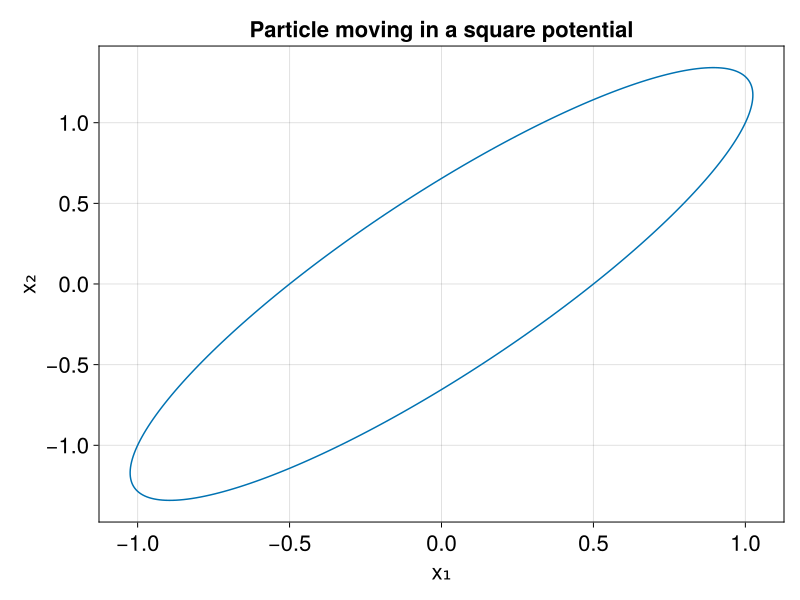
sol = integrate(lprob, Gauss(1))

using CairoMakie
fig = lines(parent(sol.q[:,1]), parent(sol.q[:,2]);
    axis = (; xlabel = "x₁", ylabel = "x₂", title = "Particle moving in a square potential"),
    figure = (; size = (800,600), fontsize = 22))
┌ Warning: Hermite Extrapolation: q's history[1] and history[2] are identical!
└ @ GeometricIntegratorsBase ~/.julia/packages/GeometricIntegratorsBase/Xm0Y1/src/extrapolation/hermite.jl:206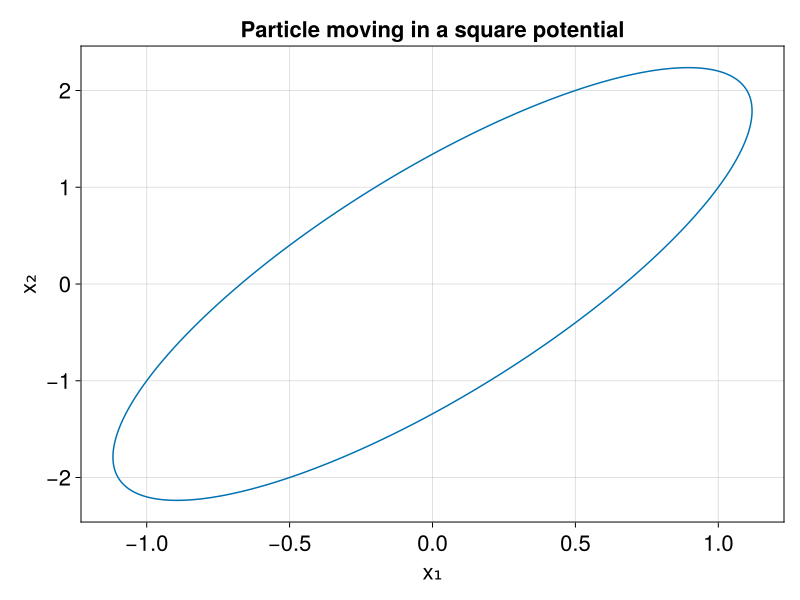
Parameters
We can also include parametric dependencies in the Lagrangian. Consider, for example, a parameter α that determines the strength of the potential.
The easiest way, to account for parameters, is to create a named tuple with typical values for each parameter, e.g.,
params = (α = 5.0,)(α = 5.0,)In the next step, we use the function symbolize to generate a symbolic version of the parameters:
sparams = symbolize(params)(α = αₚ,)Now we modify the Lagrangian to account for the parameter:
L = v ⋅ v / 2 - sparams.α * (x ⋅ x) / 2LinearAlgebra.dot(v(t), v(t)) / 2 - (1//2)*LinearAlgebra.dot(x(t), x(t))*αₚFrom here on, everything follows along the same lines as before, the only difference being that we also need to pass the symbolic parameters sparams to the LagrangianSystem constructor:
lag_sys = LagrangianSystem(L, t, x, v, sparams)
Lagrangian system with

L = ((v(t))[1]^2 + (v(t))[2]^2) / 2 - (1//2)*((x(t))[1]^2 + (x(t))[2]^2)*αₚ
Analogously, we need to pass actual parameter values params to the LODEProblem constructor via the parameters keyword argument:
lprob = LODEProblem(lag_sys, tspan, tstep, q₀, p₀; parameters = params)Geometric Equation Problem for Lagrangian Ordinary Differential Equation (LODE)
with vector fields
ϑ = RuntimeGeneratedFunctions.RuntimeGeneratedFunction{(:ˍ₋out, :t, :X, :V, :params), EulerLagrange.var"#_RGF_ModTag", EulerLagrange.var"#_RGF_ModTag", (0x4889eaba, 0x3711d03f, 0x67dd90d3, 0x9ce688d2, 0x5021471b), Expr}(:(#= /home/runner/.julia/packages/Symbolics/mLvup/src/build_function.jl:410 =# @inbounds begin
#= /home/runner/.julia/packages/Symbolics/mLvup/src/build_function.jl:410 =#
begin
#= /home/runner/.julia/packages/SymbolicUtils/c9cTZ/src/code.jl:1264 =# @inbounds begin
#= /home/runner/.julia/packages/SymbolicUtils/c9cTZ/src/code.jl:1260 =#
ˍ₋out[1] = (getindex)(V, 1)
ˍ₋out[2] = (getindex)(V, 2)
#= /home/runner/.julia/packages/SymbolicUtils/c9cTZ/src/code.jl:1262 =#
ˍ₋out
end
end
end))
f = RuntimeGeneratedFunctions.RuntimeGeneratedFunction{(:ˍ₋out, :t, :X, :V, :params), EulerLagrange.var"#_RGF_ModTag", EulerLagrange.var"#_RGF_ModTag", (0xf406ee87, 0x30cb2f9c, 0xc9577bd0, 0x5bda2b34, 0xc5655ab9), Expr}(:(#= /home/runner/.julia/packages/Symbolics/mLvup/src/build_function.jl:410 =# @inbounds begin
#= /home/runner/.julia/packages/Symbolics/mLvup/src/build_function.jl:410 =#
begin
begin
var"##cse#1" = -1//1
var"##cse#2" = (*)((*)(var"##cse#1", (getindex)(X, 1)), params.α)
var"##cse#3" = (*)((*)(var"##cse#1", params.α), (getindex)(X, 2))
#= /home/runner/.julia/packages/SymbolicUtils/c9cTZ/src/code.jl:1264 =# @inbounds begin
#= /home/runner/.julia/packages/SymbolicUtils/c9cTZ/src/code.jl:1260 =#
ˍ₋out[1] = var"##cse#2"
ˍ₋out[2] = var"##cse#3"
#= /home/runner/.julia/packages/SymbolicUtils/c9cTZ/src/code.jl:1262 =#
ˍ₋out
end
end
end
end))
g = RuntimeGeneratedFunctions.RuntimeGeneratedFunction{(:ˍ₋out, :t, :X, :V, :Λ, :params), EulerLagrange.var"#_RGF_ModTag", EulerLagrange.var"#_RGF_ModTag", (0xd78db5e6, 0x97238c19, 0xadd210ce, 0xe0bfc6f5, 0x926922e1), Expr}(:(#= /home/runner/.julia/packages/Symbolics/mLvup/src/build_function.jl:410 =# @inbounds begin
#= /home/runner/.julia/packages/Symbolics/mLvup/src/build_function.jl:410 =#
begin
#= /home/runner/.julia/packages/SymbolicUtils/c9cTZ/src/code.jl:1264 =# @inbounds begin
#= /home/runner/.julia/packages/SymbolicUtils/c9cTZ/src/code.jl:1260 =#
ˍ₋out[1] = (getindex)(Λ, 1)
ˍ₋out[2] = (getindex)(Λ, 2)
#= /home/runner/.julia/packages/SymbolicUtils/c9cTZ/src/code.jl:1262 =#
ˍ₋out
end
end
end))
Lagrangian: L = RuntimeGeneratedFunctions.RuntimeGeneratedFunction{(:t, :X, :V, :params), EulerLagrange.var"#_RGF_ModTag", EulerLagrange.var"#_RGF_ModTag", (0xf0153768, 0x17899099, 0x1469d03e, 0x352f3e28, 0x2b5e1d92), Expr}(:(#= /home/runner/.julia/packages/Symbolics/mLvup/src/build_function.jl:170 =# @inbounds begin
#= /home/runner/.julia/packages/Symbolics/mLvup/src/build_function.jl:170 =#
begin
begin
var"##cse#1" = -1//2
var"##cse#2" = 2
var"##cse#3" = (^)((getindex)(X, 1), var"##cse#2")
var"##cse#4" = (^)((getindex)(X, 2), var"##cse#2")
var"##cse#5" = (+)(var"##cse#3", var"##cse#4")
var"##cse#6" = (*)((*)(var"##cse#1", var"##cse#5"), params.α)
var"##cse#7" = (^)((getindex)(V, 1), var"##cse#2")
var"##cse#8" = (^)((getindex)(V, 2), var"##cse#2")
var"##cse#9" = (+)(var"##cse#7", var"##cse#8")
var"##cse#10" = (/)(var"##cse#9", var"##cse#2")
var"##cse#11" = (+)(var"##cse#6", var"##cse#10")
var"##cse#11"
end
end
end))
Invariants:
GeometricBase.NullInvariants()
Timespan: (0.0, 10.0)
Timestep: 0.01
Initial conditions:
(t = fill(0.0), q = [1.0, 1.0], p = [0.5, 2.0], v = [0.0, 0.0])
Parameters:
(α = 5.0,)This problem can again be integrated using GeometricIntegrators:
sol = integrate(lprob, Gauss(1))

fig = lines(parent(sol.q[:,1]), parent(sol.q[:,2]);
    axis = (; xlabel = "x₁", ylabel = "x₂", title = "Particle moving in a square potential"),
    figure = (; size = (800,600), fontsize = 22))
┌ Warning: Hermite Extrapolation: q's history[1] and history[2] are identical!
└ @ GeometricIntegratorsBase ~/.julia/packages/GeometricIntegratorsBase/Xm0Y1/src/extrapolation/hermite.jl:206