Hamiltonian Systems
Hamilton's equations of motion are given in terms of the Hamiltonian $H(q,p)$ by
\[\begin{align*} \frac{dq}{dt} &= \frac{\partial H}{\partial p} , & \frac{dp}{dt} &= - \frac{\partial H}{\partial q} . \end{align*}\]
In the following, we show how these equations can be obtained for the example of a harmonic oscillator.
Harmonic Oscillator
Before any use, we need to load EulerLagrange:
using EulerLagrangeNext, we generate symbolic variables for a one-dimensional Hamiltonian system:
t, q, p = hamiltonian_variables(1)(t, (q(t))[1:1], (p(t))[1:1])We define a named tuple with typical values for the parameters, e.g.,
params = (k=0.5, ω=√0.5)(k = 0.5, ω = 0.7071067811865476)We use the function symbolize to generate a symbolic version of the parameters:
sparams = symbolize(params)(k = kₚ, ω = ωₚ)Now we can define the Hamiltonian function:
using LinearAlgebra
H(t, q, p, params) = p ⋅ p / 2 + params.k * (q ⋅ q) / 2
H (generic function with 1 method)The Hamiltonian, evaluated on and together with the symbolic variables and parameters is used to construct a HamiltonianSystem:
ham_sys = HamiltonianSystem(H(t, q, p, sparams), t, q, p, sparams)
Hamiltonian system with

H = ((p(t))[1]^2) / 2 + (1//2)*kₚ*((q(t))[1]^2)
The constructor computes Hamilton's equations and generates the corresponding Julia code. In the last step, we can now construct a HODEProblem from the HamiltonianSystem and some appropriate initial conditions, a time span to integrate over and a time step:
tspan = (0.0, 10.0)
tstep = 0.01
q₀, p₀ = [0.5], [0.0]

hprob = HODEProblem(ham_sys, tspan, tstep, q₀, p₀; parameters = params)
Geometric Equation Problem for Hamiltonian Ordinary Differential Equation (HODE)
with vector fields
v = RuntimeGeneratedFunctions.RuntimeGeneratedFunction{(:ˍ₋out, :t, :Q, :P, :params), EulerLagrange.var"#_RGF_ModTag", EulerLagrange.var"#_RGF_ModTag", (0x273fc906, 0xc1874cc9, 0xd979d429, 0xbe19e103, 0x76983d44), Expr}(:(#= /home/runner/.julia/packages/Symbolics/KL0Tx/src/build_function.jl:456 =# @inbounds begin
#= /home/runner/.julia/packages/Symbolics/KL0Tx/src/build_function.jl:456 =#
begin
#= /home/runner/.julia/packages/SymbolicUtils/HQQQT/src/code.jl:1298 =# @inbounds begin
#= /home/runner/.julia/packages/SymbolicUtils/HQQQT/src/code.jl:1294 =#
ˍ₋out[1] = (getindex)(P, 1)
#= /home/runner/.julia/packages/SymbolicUtils/HQQQT/src/code.jl:1296 =#
ˍ₋out
end
end
end))
f = RuntimeGeneratedFunctions.RuntimeGeneratedFunction{(:ˍ₋out, :t, :Q, :P, :params), EulerLagrange.var"#_RGF_ModTag", EulerLagrange.var"#_RGF_ModTag", (0x5c9c091d, 0xcf645a9c, 0x8090a242, 0x1c03c6bc, 0x8069a395), Expr}(:(#= /home/runner/.julia/packages/Symbolics/KL0Tx/src/build_function.jl:456 =# @inbounds begin
#= /home/runner/.julia/packages/Symbolics/KL0Tx/src/build_function.jl:456 =#
begin
begin
var"##cse#1" = -1//1
var"##cse#2" = (*)((*)(var"##cse#1", (getindex)(Q, 1)), params.k)
#= /home/runner/.julia/packages/SymbolicUtils/HQQQT/src/code.jl:1298 =# @inbounds begin
#= /home/runner/.julia/packages/SymbolicUtils/HQQQT/src/code.jl:1294 =#
ˍ₋out[1] = var"##cse#2"
#= /home/runner/.julia/packages/SymbolicUtils/HQQQT/src/code.jl:1296 =#
ˍ₋out
end
end
end
end))
Hamiltonian: H = RuntimeGeneratedFunctions.RuntimeGeneratedFunction{(:t, :Q, :P, :params), EulerLagrange.var"#_RGF_ModTag", EulerLagrange.var"#_RGF_ModTag", (0x202247eb, 0x2ca2b608, 0xbac538b0, 0xc85941d1, 0x1a9b6ee4), Expr}(:(#= /home/runner/.julia/packages/Symbolics/KL0Tx/src/build_function.jl:198 =# @inbounds begin
#= /home/runner/.julia/packages/Symbolics/KL0Tx/src/build_function.jl:198 =#
begin
begin
var"##cse#1" = 1//2
var"##cse#2" = 2
var"##cse#3" = (^)((getindex)(Q, 1), var"##cse#2")
var"##cse#4" = (*)((*)(var"##cse#1", var"##cse#3"), params.k)
var"##cse#5" = (^)((getindex)(P, 1), var"##cse#2")
var"##cse#6" = (/)(var"##cse#5", var"##cse#2")
var"##cse#7" = (+)(var"##cse#4", var"##cse#6")
var"##cse#7"
end
end
end))
Invariants:
GeometricBase.NullInvariants()
Timespan: (0.0, 10.0)
Timestep: 0.01
Initial conditions:
(t = fill(0.0), q = [0.5], p = [0.0])
Parameters:
(k = 0.5, ω = 0.7071067811865476)We can integrate this system using GeometricIntegrators:
using GeometricIntegrators
sol = integrate(hprob, Gauss(1))

using CairoMakie
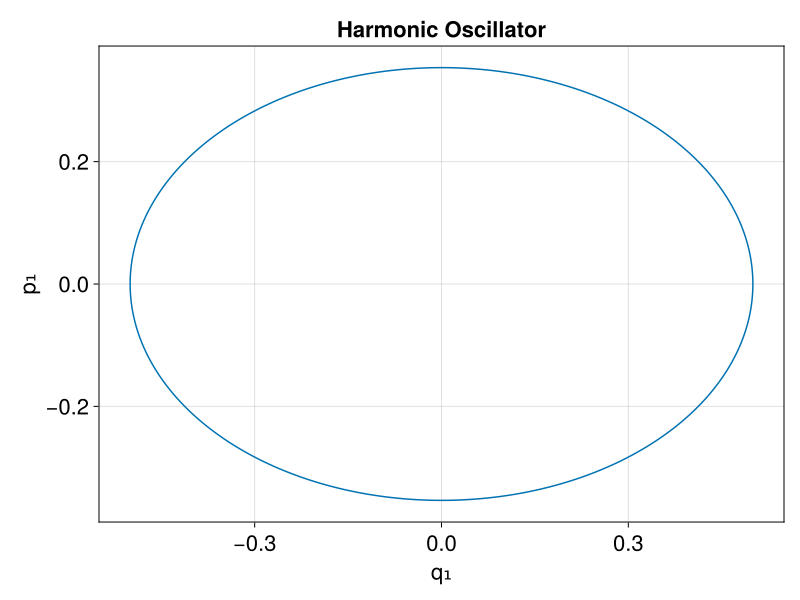
fig = lines(parent(sol.q[:,1]), parent(sol.p[:,1]);
    axis = (; xlabel = "q₁", ylabel = "p₁", title = "Harmonic Oscillator"),
    figure = (; size = (800,600), fontsize = 22))